
“Color is my day-long obsession, joy and torment.” — Claude Monet
Just Before Evening — A Study in Transition, Memory, and Light
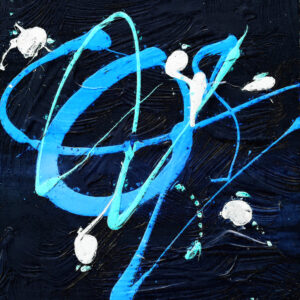
In Just Before Evening, Michael John Valentine continues his exploration of liminal space—the charged moment where day dissolves into night and perception shifts from the literal into the emotional. This work is not simply a depiction of atmosphere; it is an immersion into the psychological threshold of dusk, where memory, color, and sensation begin to blur into one another.
The painting exists in that fragile interval where everything feels suspended. Light is no longer assertive, but not yet absent. Forms do not disappear so much as they soften, surrendering definition to mood. It is within this in-between state that Valentine’s signature mixed media language becomes most expressive, layering abstraction, photographic grounding, and painterly intervention into a unified visual field.
The Language of Overpainting
At the core of Valentine’s process is his disciplined yet intuitive method of overpainting. Each work begins with an underlying compositional foundation—often informed by photographic reference or digitally derived structure. This base acts not as a final image, but as an anchor point: a memory of reality rather than reality itself.
From there, the painting is transformed through successive layers of acrylic application. These layers are not additive in a purely decorative sense; they are subtractive, corrective, and expressive all at once. Forms are partially obscured, reintroduced, and then dissolved again, allowing the surface to accumulate visual history. In Just Before Evening, this manifests as atmospheric depth—fields of softened pigment where earlier structures still faintly echo beneath the surface.
This technique of overpainting creates a sense of temporal compression. The viewer is not seeing a single moment, but multiple moments stacked upon each other. Each layer contains evidence of decisions made and revised, giving the work a quiet archaeological quality. The painting becomes less an image and more a record of becoming.
Glazing as Atmospheric Architecture
Once the structural layers are established, Valentine introduces glazing—a critical stage that transforms surface into atmosphere. Thin, translucent veils of acrylic medium are applied to unify the composition, soften transitions, and modulate light interaction across the canvas.
In Just Before Evening, glazing functions almost like weather. It diffuses edges, deepens tonal relationships, and creates the sensation that light is moving through the painting rather than sitting on top of it. The viewer experiences this as a shift in spatial perception: foreground and background lose rigidity, replaced by a continuous field of luminous depth.
This final glazing stage also acts as a protective seal, preserving the integrity of the layered composition beneath. As noted in Valentine’s broader body of work, the process often concludes with a final protective glazing layer designed to stabilize the surface and ensure longevity while maintaining optical clarity and vibrancy.
Mixed Media as Emotional Structure
Valentine’s approach is distinctly mixed media, but not in the conventional sense of combining disparate materials for contrast. Instead, his practice integrates mediums into a unified perceptual system. Acrylic paint, photographic reference, tonal underpainting, and glazing are not separate steps—they are interdependent phases of a single evolving language.
This is especially evident in Just Before Evening, where the tension between control and dissolution defines the emotional register of the work. Hard edges occasionally emerge, only to be softened by translucent overlays. Color fields assert themselves, then recede into atmospheric haze. The result is a painting that feels alive with internal weather systems—constantly shifting, never fixed.
The overpainting process is essential here because it resists finality. It allows Valentine to continuously negotiate between structure and intuition. Rather than preserving a single decisive gesture, he builds complexity through revision, creating surfaces that feel lived-in rather than composed.
The Emotional Physics of Dusk
The conceptual foundation of Just Before Evening lies in transition. Dusk is not merely a time of day; it is a psychological condition. It is when perception becomes less certain and more interpretive. Shadows lengthen, colors deepen, and the familiar world begins to feel slightly detached from its earlier clarity.
Valentine translates this condition into visual form through layered tonal modulation. Warm undertones may emerge briefly before being subdued by cooler atmospheric veils. This push and pull generates a rhythm that mirrors the emotional experience of evening itself—calm, reflective, and subtly unresolved.
There is also a cinematic quality to the composition. Rather than presenting a fixed scene, the painting feels like a frame extracted from a longer unfolding sequence. The viewer enters mid-transition, as though stepping into a moment already in progress and leaving before it fully resolves.
Craftsmanship and Collector Experience
From a collector’s perspective, Just Before Evening represents the convergence of process and permanence. Each layer of overpainting contributes to a depth that cannot be replicated through reproduction alone. The tactile richness of the surface—its subtle shifts in opacity, texture, and light response—becomes part of the viewing experience.
The glazing stage further elevates this experience by creating optical continuity across the surface. Light interacts with the painting in a dynamic way, revealing different tonal relationships depending on viewing angle and ambient conditions. This ensures that the work remains visually active over time, rewarding repeated engagement.
Valentine’s method also reflects a broader philosophy of authorship. The painting is not simply executed; it is constructed through accumulation, revision, and refinement. Each decision remains partially visible beneath the surface, contributing to the work’s sense of depth and authenticity.
A Moment Held in Suspension
Ultimately, Just Before Evening is less about depicting a scene than about preserving a sensation. It captures the emotional weight of transition—the quiet awareness that one state of being is dissolving while another has not yet arrived.
In this sense, the work aligns with Monet’s belief that color is both joy and torment: something deeply felt, never entirely controlled. Valentine channels this duality through his layered process, allowing structure and dissolution to coexist on the same surface.
The result is a painting that does not conclude, but lingers. Like dusk itself, it resists closure. Instead, it offers a space for contemplation—an invitation to inhabit the moment just before everything changes.
A Special Modern Abstract Series about time, memory, atmosphere, and fleeting perfection.
The Series Includes the following releases- The Shape Of A Perfect Day, A Day Worth Holding, The Calm After Color, The Day That Found Us, Just Before Evening, Before The Day Breaks, A Sky That Wouldn’t Leave, After The Light Fades, A Moment Without End, The Day That Stayed, The Longest Light, One Fine Day
The Exhibition Canvas comes in 3 sizes and goes through several steps that include overpainting with acrylics, signing with acrylics on the front and a final glazing to protect the canvas before being rolled in a sealed tube then a box ( shipping is free in the USA )
The Matted Prints come in 3 sizes and are shipped in a box. ( shipping and handling is free in the US)
The Glossy Poster Print measures 16 x 24 and arrives in a sealed tube that is placed in a box. ( shipping is free in the US )
The 4 Inch Round Peel And Stick Decal is perfect for many applications beyond cars and comes in a sealed envelope ( shipped for free )